
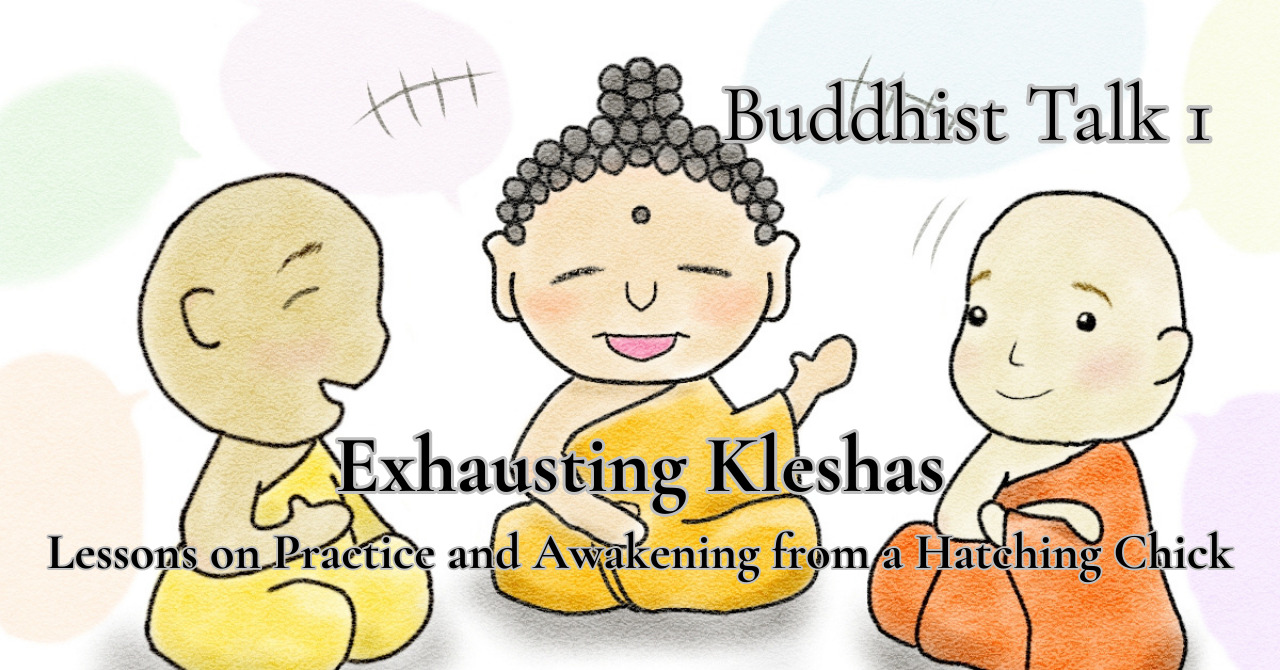
The following is based on “Zāḥāgama Sutra 10-263”. The sutra content has been presented in a conversational format, like a group chat, with Buddha and his disciples talking.
What does it mean that Kleshas are exhausted?
Buddha and his disciples were discussing what it means for Kleshas (煩悩) to be exhausted, and what it means to awaken.
A person who has attained awakening is someone whose kleshas are gone.
Everyone vaguely thinks so, right?
Yes, and conversely, someone with kleshas has not yet awakened.
Awakened person = kleshas exhausted.
Unawakened person = kleshas remain.
We often hear this, but Master, what do you think?
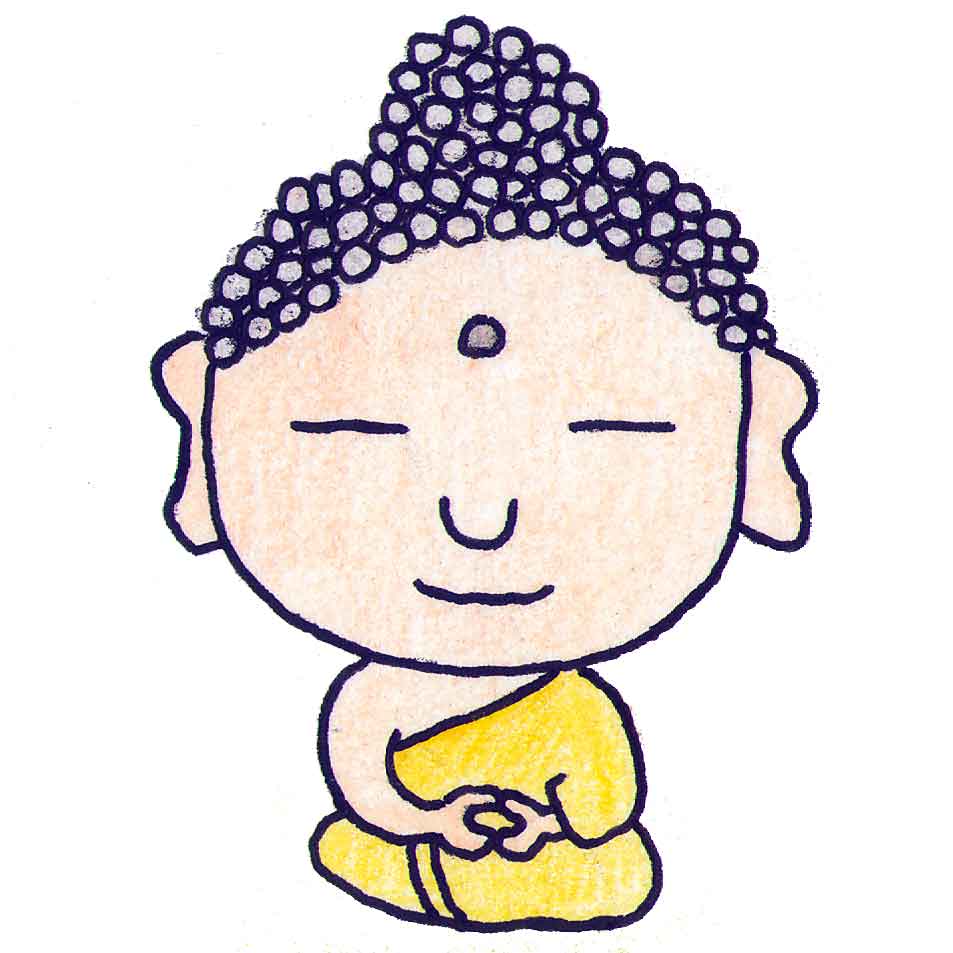
What does it mean to awaken, to exhaust kleshas?
Who is the person who, by knowing or seeing something, exhausts kleshas?
Considering the body and mind
Huh?
What should we know to awaken?
What should we see to exhaust kleshas?
Let’s change our perspective a bit.
For example, here is my body.
Can you see it?
Of course. I see it.
That’s the Master’s body.
What is this body?
The body is the body. That’s obvious.
…?
Sorry, I don’t understand the question.
Let’s change the question a bit.
Why is the body here now?
Um… because it was born?
Because we build it by eating, drinking, and so on.
Is that all?
Let’s ask differently: what is the body made of?
Bones, muscles, organs, blood… there’s no end.
If we count cells, there are said to be 37 trillion or even 60 trillion.
Is that all?
No. As I said, without food we cannot live, so the body is also made from food.
If you say that, we cannot live without air and water either.
True. So air and water are necessary too.
Wait… but then there are trees producing oxygen, the earth, the sun…
It’s endless.
Yes, but all are essential.
This discussion is endless, but let’s change the question again.
What will happen to the body from now?
What happens to this body?
Well, people die eventually.
The body will eventually decay.
Like any object breaking, the body will also break, or we might say, perish.
How will it perish?
Huh?
You mean, it gets old?
As we age, our bodily functions weaken. But in youth, we grow continuously.
Then, how does it change?
Cell division, I guess.
Wrinkles form, you can lift heavy things, or can’t lift them anymore. Those are changes too.
Ah, yes. That’s change.
Even my physical condition changes day by day.
Looking at each cell, countless cells are born and die every day. That’s metabolism.
I see.
Now, let’s consider things other than the body.
Other things?
Like with the body, it would be endless, right?
Yes, consider the mind.
Try applying the same questions to your mind.
Huh? The mind too? Um…
Can we even see the mind?
We observe the mind, not visually.
What is the mind?
Why is it here now?
What is it made of?
What will happen to it?
Sorry, the discussion is expanding too much. Can we return to the original question?
Who is the person whose kleshas are exhausted?
Yes.
A person who sees like this, who knows like this, their kleshas are exhausted.
Huh? We answered exactly as you asked.
Does that mean we are already awakened!?
No, that can’t be.
We could follow the conversation, understand it, observe, and see, and we could know things.
Yes, we understood the words, but simply seeing and knowing is not enough…
Thinking from a Chick Hatching
Now, imagine a chicken egg.
You know chicks hatch from eggs, right?
Yes, of course.
That is, a fertilized egg.
Fertilized egg?
Doesn’t any egg hatch if warmed?
Only fertilized eggs hatch. The ones we eat are usually unfertilized.
Ah, so the egg the Master mentioned is fertilized. We know chicks are born from eggs.
Yes. If you only know, will chicks hatch?
I know eggs must be warmed.
The chick breaks the eggshell and hatches.
Why?
Because it was warmed.
Kleshas are exhausted naturally.
Why?
Through practice.
Ah, just knowing isn’t enough. It requires action.
Practice = warming.
So we just need to warm, right?
I know that. Simple.
Even warming is not simple; raising chicks is actually very difficult. Temperature control is hard.
Easier said than done.
I’ve never actually warmed eggs myself, though I know it’s needed.
Like chicks breaking their shells, I must break my own shell.
That’s why practice is necessary—to exhaust kleshas and awaken!
Even without deciding, the chick breaks the shell and hatches naturally.
Why? Because it is warmed.
Kleshas are exhausted naturally.
Why? Through practice.
So it doesn’t matter how much we think about it.
It would be unnatural if the chick said, “I must break this shell,” and “I am breaking it now.”
Yes. Kleshas are exhausted naturally.
Why? Through practice.
When will it happen?
How long should I practice?
The Lumberjack Analogy
Let’s consider a master lumberjack and his apprentice.
The master handled his axe expertly and taught the apprentice carefully—how to hold, swing, and cut.
The apprentice followed instructions and swung the axe diligently.
We are also taught like this, Master.
Once taught, the only thing left is to keep swinging.
Day after day, the apprentice swung the axe.
He developed blisters and hardened skin, but noticed no small changes.
The master observed his hands and fingers.
When will I become a master like him?
One day, the apprentice’s axe broke.
Then the master recognized him as fully trained.
So when the axe breaks, I am a master?
When will my axe break?
The master watches, but does not know if it will break today or tomorrow.
But he knows it will break properly, someday.
We don’t know when, but we know it will eventually happen.
Then we just wait?
Waiting alone won’t do.
True, waiting is not enough.
Kleshas are exhausted naturally.
No one knows if it will be today or tomorrow.
Yet my disciples know that kleshas will be exhausted.
Why? Through practice.
日本語版はこちら
コメント